Premade Cabinets: Where to Spend and Save
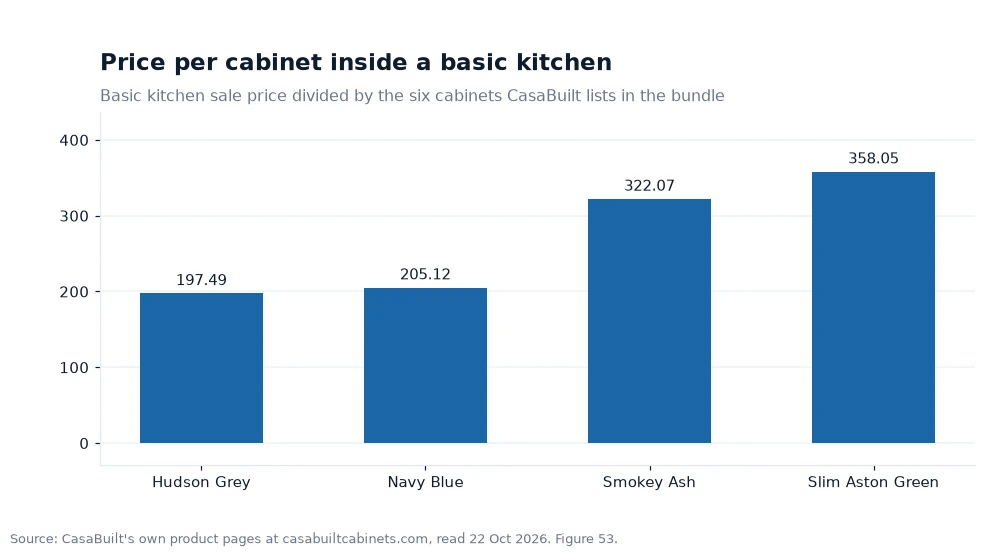
Cabinet budgets fail in two directions: too much on the door, too little on the box. CasaBuilt publishes one hardware specification across its lines — soft-close concealed hinges, undermount full-extension glides, dovetail drawers — so the variable in the price is the finish, not the mechanism. Inside a basic kitchen that variable runs from $197.49 to $358.05 per cabinet, a spread wide enough to buy several extra cabinets instead.
Key takeaways
- Hinges, glides and drawer boxes are the same specification across the published range, so they are not an upgrade path.
- The per-cabinet price inside the basic bundle runs from $197.49 in Hudson Grey to $358.05 in Slim Aston Green.
- A $2,500 budget buys twelve cabinets at $197.49 but only six at $358.05.
- Free shipping starts at $2,500, so the last few hundred dollars of a budget do double duty.
Three places the money goes
Every cabinet price is three prices added together: the box, the door and the hardware. The box is the carcase — sides, back, shelves, face frame. The door is the panel the room actually sees. The hardware is the hinges, glides and any pull-out mechanism. Most buyers assume all three scale together, so a more expensive cabinet must be better in every respect. The published specification says otherwise.
CasaBuilt lists a 1/2-inch birch plywood box with a natural birch interior, a 3/4-inch by 1-1/2-inch solid birch face frame, 5/8-inch rubberwood dovetail drawers and 3/4-inch adjustable plywood shelves. It lists the same soft-close concealed six-way adjustable hinges and the same soft-close undermount full-extension glides. Those parts do not change when the door changes. That single fact reorganizes the whole budget: paying more buys a finish, and only a finish.
Which is good news for anyone who assumed a mid-range budget meant mid-range hardware. It also means the upgrade conversation should never start with hinges. If two quotes differ by a thousand dollars and both describe soft-close undermount glides, the difference is the panel and the paint.
Doors can be replaced. A box cannot, without replacing the cabinet. That makes the carcase the one place where saving money is a permanent decision, and it is why the published materials deserve more attention than the color chart. Birch plywood is a plywood, with layers, not a molded board, and the face frame is solid birch at 3/4 inch by 1-1/2 inch rather than a thin applied strip.
The interior finish matters for a less obvious reason: a natural birch interior is light, so a dark cabinet does not become a dark cave when the door opens. The exterior sides are color-matched, which is what allows a run to look finished where a cabinet end is exposed at the end of a peninsula. A buyer comparing two prices should check both of those details before deciding which cabinet is the better box.
The drawers are worth a sentence of their own. Dovetail joints at 5/8-inch rubberwood are a joinery decision, not a cosmetic one, and they are listed as standard rather than as an upgrade. Where a cheaper cabinet saves money is usually here, with a stapled or doweled box that looks identical from the front and sounds different after two years of pans.
The finish is the line that moves
Everything above the box is where the price spreads out. The published sample library covers five whites, three grays, two browns, one black, one beige, one green and one navy across 16 door samples, and the range of premade cabinets runs from painted Shaker profiles to slim oak-look and high-gloss finishes. The published bundle prices sort into tiers: the painted Shaker lines sit near $1,185 to $1,231, the Smokey Ash line at $1,932.42, and the slim lines above $2,100.
The chart takes the same bundle and divides by six, which is the fair way to compare a finish decision against a cabinet decision. Hudson Grey comes out at $197.49 per cabinet, Navy Blue at $205.12, Smokey Ash at $322.07 and Slim Aston Green at $358.05. A buyer can then ask a concrete question: is this finish worth one and a half extra cabinets? Sometimes it is, particularly in a small kitchen where the door is most of what the room shows.
Where the answer is usually no is a large kitchen with a lot of wall cabinets. Forty doors in a premium finish is a much bigger commitment than six, and the visual return per dollar drops as the room gets busier. The honest test is to price the same plan in two finishes and look at the difference as a number rather than a percentage, because a percentage hides the fact that the money could be a range hood.
Save where it shows least
The cheapest saving is not a cheaper door. It is fewer doors. A 36-inch base cabinet at $586.28 costs less per inch of width than a 30-inch base at the same price, and two 36-inch cabinets hold more than three 24-inch ones for less money. The same logic applies to wall cabinets: wider units use the same hinges and the same panel area per inch as narrower ones, so the price per inch falls as the width rises.
The second saving is height. Wall cabinets come in 30, 36 and 42 inches, all 12 inches deep. The 42-inch version adds storage and cost; the 30-inch version leaves wall space that a buyer may prefer anyway. Neither is an upgrade in build quality. The third saving is decorative: glass stackers, corner mechanisms and pull-out bases are conveniences, not structural improvements, and each one consumes budget that could go into the box or into the width of the run.
Then there is the shipping threshold. Free shipping begins at $2,500, which turns the last part of the budget into a decision about freight. A plan that lands at $2,300 is paying freight on top; a plan at $2,520 is not. CasaBuilt's design-to-budget estimator is built for exactly this step, and it is faster than adding rows in a spreadsheet.
Where the budget actually lands
The table below holds the budget fixed at $2,500 and asks how many cabinets each per-cabinet price buys, then what is left over. It is a deliberately blunt measure: a real kitchen has a fixed plan, so the cabinet count cannot float. Read it as the cost of choosing a finish, expressed in cabinets rather than in dollars.
| Line | Price per cabinet | Cabinets bought with $2,500 | Spend | Left over |
|---|---|---|---|---|
| Hudson Grey | $197.49 | 12 | $2,369.88 | $130.12 |
| Navy Blue | $205.12 | 12 | $2,461.44 | $38.56 |
| Smokey Ash | $322.07 | 7 | $2,254.49 | $245.51 |
| Slim Aston Green | $358.05 | 6 | $2,148.30 | $351.70 |
Two rows are instructive. Navy Blue spends $91.56 more than Hudson Grey for the same twelve cabinets and leaves $38.56, a finish decision almost anyone would call cheap. Slim Aston Green buys half as many cabinets and still leaves more in reserve than Navy Blue spends in total.
Worked example: the spread per cabinet
The chart gives four per-cabinet prices: Hudson Grey $197.49, Navy Blue $205.12, Smokey Ash $322.07 and Slim Aston Green $358.05. Take the ends first. Subtract $197.49 from $358.05 and the difference is $160.56 per cabinet. Multiply by twelve cabinets and the same upgrade costs $1,926.72 — nearly the whole of a $2,500 budget spent again on finish alone.
Divide the two ends instead of subtracting them: $358.05 divided by $197.49 is 1.81, so the Slim Aston Green cabinet carries 81% more price than the Hudson Grey one. The middle of the range is tighter than the ends suggest. Navy Blue is only $7.63 above Hudson Grey, while Smokey Ash is $116.95 above Navy Blue — the largest single step in the chart, and the one worth interrogating before signing.
Apply the step to a six-cabinet bundle and the arithmetic matches the published prices. The $160.56 spread times six is $963.36, which is the difference between a $1,184.93 bundle and a $2,148.28 one to within a few cents of rounding. That is the number to hold in mind when a showroom conversation drifts toward the finish: it is not a small upgrade, it is a second order's worth of money.
Frequently asked questions
Is it worth paying more for a better hinge?
There is no hinge upgrade to buy. The published specification already includes concealed soft-close hinges with six-way adjustment and soft-close undermount full-extension glides across the range. Money spent above the entry line buys a door finish, not better hardware, so the comparison should be made on the panel and the paint.
Where is the safest place to cut a cabinet budget?
Width and door count, not the box. A plan built from wider cabinets needs fewer units for the same run length, which saves hinges, panels and assembly time at once. Cutting the box material is the one saving that cannot be reversed later without replacing the cabinet.
Should I stay just above $2,500 to get free shipping?
Only if the extra cabinet is one the kitchen needs. Free shipping starts at $2,500, so an order at $2,460 pays freight on the whole shipment while an order at $2,520 does not. Adding a wall cabinet that will eventually be wanted is a sensible way to cross the line; buying a cabinet with no position is not.
Build the budget from the box up
Price the box first, confirm the hardware specification in writing, then choose the finish against a real sample in the room. Decide how many cabinets the plan needs before deciding how expensive each one is. A kitchen that spends its money on width and on a finish it will still like in five years does not need to be bought twice.
Figures quoted here come from the manufacturer's own website, read 22 Oct 2026[1.