Moving Between Settlements: A Switcher's Field Notes on PPS+ and PPLNS
Changing settlement feels like changing shifts at the same factory: same machines, different rhythm of pay. At 1,142 TH/s the daily gross sits near $43.39, with the listed PPS+ block-reward charge at $1.74 against $0.87 for the PPLNS-distributed slices. The notes below come from a miner who ran both and measured the difference instead of debating it.

Key takeaways
- 1,142 TH/s grosses about $43.39 a day at $84,692 per BTC and current difficulty.
- Listed PPS+ charge on the block reward runs $1.74 daily; PPLNS slices cost $0.87.
- PPS+ settles hourly while PPLNS divides earnings after 6 confirmations over 5 difficulty rounds.
- Switch only after two full weeks of clean uptime data on the current scheme.
Why a steady miner starts questioning the default
The default serves newcomers well. PPS+ converts every valid share into an hourly credit against current difficulty, shielding the miner from the pool's own dry spells and orphan blocks. For the first months that shelter is worth every cent of the listed 4% on the PPS-settled block-reward component. Then the operation stabilizes, uptime climbs past 99% and curiosity arrives with the electricity bill.
The question that follows is legitimate: with machines rarely offline, does paying for hourly certainty still make sense, or would sharing the pool's variance at a listed 2% leave more coins over a quarter? There is no universal answer, only a personal one written in the operator's cost structure. A site with fixed industrial power and salaried staff values predictability differently than a garage with flexible costs.
Measurement beats theory. Run the current scheme for a fortnight with the machines steady, record daily credited coins, and compute the average kept per day. Only that baseline makes the alternative comparable. Switching on a hunch during a lucky or unlucky week teaches nothing except how randomness feels.
Living on the hourly staircase for a month
Life under PPS+ has a metronome quality. Twenty-four credits a day, each near one twenty-fourth of the daily figure, accumulate regardless of whether the pool found three blocks or none that hour. At 1,142 TH/s the daily gross of $43.39 trims by the $1.74 listed block-reward charge to $41.65 on that slice, a number that repeats with reassuring dullness while difficulty 132.76 T holds.
The dullness is the product. Budgeting turns trivial: multiply the daily kept figure by thirty, subtract power, and the remainder funds the next decision. Variance still exists, but it lives in difficulty adjustments and the BTC price, estimated next near minus 2.12%, rather than in block discovery. Operators who sleep better knowing tomorrow resembles today are paying for rest as much as for coins.
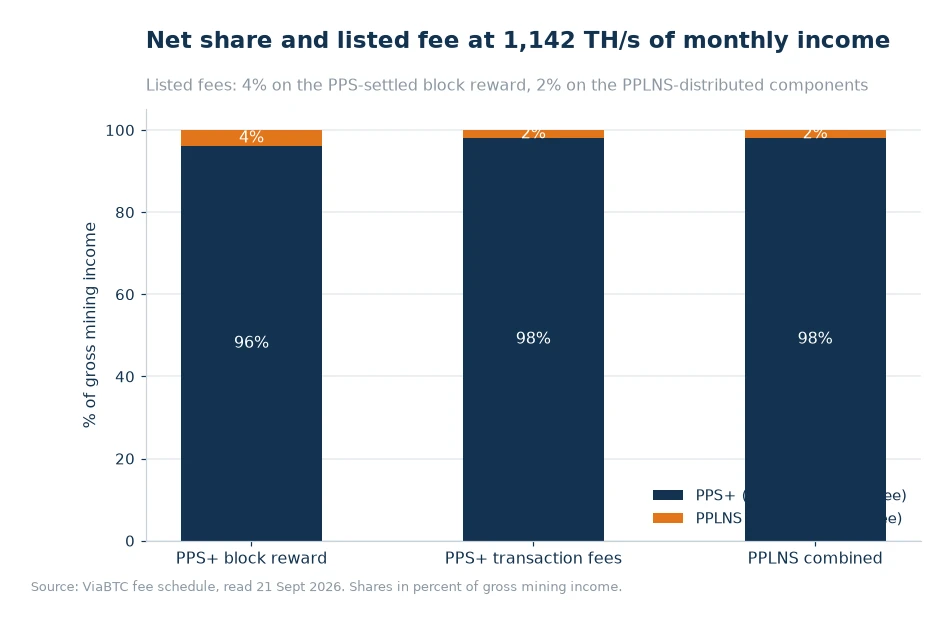
Full rate tables live on the ViaBTC Pool Fees page, where the listed 4% sits beside the PPS-settled block reward and the listed 2% beside the transaction-fee and PPLNS rows. Read them as labels on separate jars. The mistake that launched a thousand forum arguments is pouring both jars into one percentage.
Trying the shared pot with eyes open
PPLNS replaces the metronome with weather. Block rewards plus transaction fees merge into one distribution, divided after 6 confirmations according to each miner's slice of pool work across the last 5 difficulty rounds. The listed 2% on the combined pot costs $0.87 a day at 1,142 TH/s, leaving $42.52 on an average day, higher than the PPS+ net, with wider daily swings around it.
The window rule shapes behavior. Because only recent rounds count, shares submitted during a pool hot streak pay generously while idle hours during the same streak earn nothing. A container site with disciplined maintenance thrives here; a hobby rig rebooted whenever its owner remembers does not. Before switching, confirm a full month above 98% uptime, or the comparison will punish the operator rather than the scheme.
Pool context helps during the trial. The pool state overview shows current Pool Hashrate, recent blocks and luck indicators, so a thin week can be attributed correctly to cold variance instead of misconfiguration. Keep a daily log of credited coins beside those readings; after thirty days the average speaks clearly.
A switcher's ledger at 1,142 TH/s
The table converts the schedule into a monthly budget at this hashrate, showing what each style costs and keeps across thirty days. The chart behind it visualizes the same split as kept shares. Together they frame the only question that matters: is the roughly $26 monthly gap between the two block-reward paths worth the calm it buys?
| Slice | 30-day gross | 30-day listed cost | 30-day kept |
|---|---|---|---|
| PPS+ block reward | $1,301.70 | $52.20 | $1,249.50 |
| PPS+ transaction fees | $1,301.70 | $26.10 | $1,275.60 |
| PPLNS combined | $1,301.70 | $26.10 | $1,275.60 |
Most switchers discover their temperament in the first cold week. If a three-day dip below the hourly pace prompts no urge to tinker, the shared pot fits. If it prompts midnight setting changes, the hourly staircase was the right home all along. Neither reaction is wrong; mismatching temperament to settlement is the only error.
Keeping honest records across the switch
A settlement trial without records is just a mood swing with extra steps. Open a simple ledger with one row per day: date, credited coins, settlement mode, pool luck reading and a one-line note on uptime events. After two weeks on each scheme the averages become trustworthy, and the comparison stops depending on anyone's memory of how a particular Tuesday felt.
Price noise deserves its own quarantine. Convert each week's coins at that week's average BTC price rather than at Saturday night's spike, so market drama cannot masquerade as settlement performance. At 1,142 TH/s the expected gap between schemes is only about $0.87 a day on the relevant slices, small enough that sloppy conversion dates can flip the apparent winner. Clean books protect the decision from the market's theater.
Switchbacks are free, so treat the first change as reversible rather than final. If thirty logged days show the shared pot trailing the old hourly net after honest conversion, revert without embarrassment; the experiment still purchased certainty about personal temperament. Keep the ledger running after the decision too, since difficulty and pool size drift across seasons and today's right answer deserves rechecking each quarter.
Worked example
Derive the baseline from network totals. Daily BTC per TH/s equals 450 divided by 1,003,000,000, or 0.00000044865. For 1,142 TH/s, multiply: 1,142 times 0.00000044865 gives 0.00051236 BTC per day. At $84,692 that is $43.39 gross. The listed 4% on the PPS-settled block-reward component is $43.39 times 0.04, equal to $1.74 a day, leaving $41.65. The listed 2% on the PPLNS-distributed components is $43.39 times 0.02, equal to $0.87 a day, leaving $42.52. Monthly, those charges become $52.20 and $26.10, the figures in the ledger above.
Frequently asked questions
Can I switch settlement without moving machines?
Yes. Settlement is an account setting, so the workers keep hashing through the change; only the timing and variance of credits shift, from hourly PPS+ to post-confirmation PPLNS shares.
How long should I trial the new scheme?
At least thirty days at stable uptime. PPLNS needs the full window of the last 5 difficulty rounds plus pool luck cycles to reveal its true average near $42.52 a day at this size.
Does withdrawing cost differ between schemes?
No. Both settle into the same account with zero-fee mining payouts, so the switch changes credit rhythm, not withdrawal economics.
Test, log and then choose deliberately
Hold the current scheme for two measured weeks, switch once, and log thirty days of the new rhythm against pool luck readings. If the average beats the old net and the swings never cost sleep, stay. Otherwise switch back knowing the $26 monthly premium bought exactly what it advertised: calm, delivered hourly. A profit projection page can refresh the gross baseline whenever difficulty moves, keeping the comparison honest across seasons.
Sources: ViaBTC pricing and pool-state pages for the listed 4% and 2%, hourly PPS+ rhythm and PPLNS confirmation rules. Chain inputs read 21 Sept 2026: hashrate about 1,003 EH/s, difficulty 132.76 T, 3.125 BTC subsidy, 144 blocks daily, BTC $84,692. Published 11 Nov 2026; figures assume continuous uptime[1].